
The Numbers Tell a Difficult Story
Only 2.5% of Nigerian women solely own a home.
That figure drawn from the World Bank Gender Data Portal sits alongside another that is equally striking: 89% of Nigerian women do not own any property at all. Meanwhile, men’s sole ownership stands at 24%.
The gap is not a rumour or a feeling. It is a documented, measurable reality backed by data from the World Bank, the National Bureau of Statistics, and the Federal Government’s own Women’s Economic Empowerment policy framework, which confirmed in 2023 that only one in ten landowners in Nigeria is female.
So what is holding Nigerian women back? And more importantly, what can actually close the gap?
The answer, increasingly, is the strategic use of mortgage financing.
In a market where property prices in Lagos corridors like Lekki, Ajah, and Ikorodu have risen year on year, waiting to save the full purchase price is not a conservative strategy. It is an expensive one.
This article breaks down exactly how mortgages work in Nigeria, what government-backed options are available right now, and how financially active women can position themselves to access them.
Why Saving in Full Is Not the Safe Option You Think It Is
Here is a scenario worth sitting with.
A two-bedroom apartment in an estate in Lekki Extension currently ranges from ₦80 million to ₦200 million. Nigeria’s real estate market has been growing at a compounded annual growth rate of approximately 7%, and the broader market, valued at $29.2 billion in 2024, is projected to reach $40 billion by 2030.
That means a property you cannot afford today becomes harder to afford every year you wait.
Now consider what happens when you use a mortgage instead. Rather than saving the full ₦35 million over several years as the price rises, you put down 10–30% upfront, secure the property at today’s price, and pay the remainder over 10-30 years. During that period, the property continues to appreciate — and inflation gradually erodes the real cost of your fixed repayments.
This is not a trick. It is how wealth-building through real estate actually works.
The challenge in Nigeria has been access: limited lenders, high commercial interest rates, and documentation barriers have kept mortgages out of reach for most women. But that is changing — faster than many people realise.
The Mortgage Landscape in Nigeria in 2026: What You Need to Know
There are three main pathways for mortgage financing in Nigeria:
1. The National Housing Fund (NHF): The Most Affordable Option
The NHF, managed by the Federal Mortgage Bank of Nigeria (FMBN), remains the most accessible and lowest-cost mortgage product in the country. Here is what it currently offers:
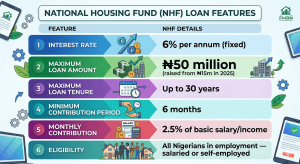
The FMBN raised the NHF loan ceiling from ₦15 million to ₦50 million in February 2025, a significant increase designed to serve higher-income earners in the private sector while still serving low- and middle-income contributors.
At 6% per annum, FMBN is currently the only financial institution in Nigeria offering single-digit mortgage interest rates. That is not a minor advantage. It is the difference between a mortgage that works within your budget and one that suffocates it.
To access the NHF, you need to register with the scheme through your employer or independently as a self-employed contributor, contribute for a minimum of six months, and apply through an accredited Primary Mortgage Bank (PMB).
2. Ministry of Finance Incorporated Real Estate Investment Fund (MREIF)
Launched in early 2025, MREIF offers another government-backed option at 9.75% fixed interest, with loan terms of up to 20 years and down payments as low as 10%. Importantly, both NHF and MREIF allow borrowers to use their pension contributions toward the down payment, a feature that significantly reduces the initial cash requirement.
3. Commercial Banks and Primary Mortgage Banks
Commercial lenders currently charge between 15% and 28% per annum, tied to the CBN’s monetary policy rate of 27.5%. These products offer faster processing and higher loan amounts, but the cost is substantially higher. For most women entering the market for the first time, government-backed options should be the starting point.
A Real Scenario: What a Mortgage Actually Looks Like for a Nigerian Woman
Let’s put real numbers to this.
Profile: Adaeze, 34, works as a marketing manager in Lagos. Her net monthly income is ₦450,000. She wants to buy a two-bedroom apartment in the Ikorodu estate valued at ₦35 million.
Without a mortgage:
- She saves ₦100,000 per month toward the purchase.
- At that rate, she saves ₦35 million in approximately 29 years.
- By then, the same apartment could be worth significantly more — or it may no longer exist at that price point.
With an NHF Mortgage:
- She contributes 2.5% of her income (₦11,250/month) to the NHF for 6 months to qualify.
- She makes a 20% down payment of ₦7 million.
- She borrows the remaining ₦28 million at 6% over 25 years.
- Estimated monthly repayment: approximately ₦180,000 — within the financial guideline of keeping housing costs below one-third of net income.
- She moves in now. The property appreciates. Her debt gradually decreases in real terms as inflation works against the fixed loan value.
This is not theoretical. These are the actual terms available through the FMBN today.
Addressing the Real Barriers: Not the Surface Ones
The original barriers Nigerian women face around mortgages go deeper than fear of debt. Understanding the actual landscape matters.
Related: Renting vs. Getting a Mortgage in 2025 Nigeria: Which Makes More Financial Sense?
“I’m Self-Employed — Can I Still Qualify?”
Yes. The NHF explicitly includes self-employed Nigerians. What lenders assess is not your employment type but your income consistency. To strengthen your application as a self-employed woman, you need:
- At least 6 months of clean, consistent bank statements
- A CAC business registration certificate
- Proof of income inflows (invoices, contracts, bank credits)
- Tax records, where available
A business account with regular, documented income is the functional equivalent of a payslip for most mortgage assessors.
“I’m Single — Will That Affect My Application?”
Marital status is not a legal criterion for mortgage eligibility in Nigeria. Sections 43 and 44 of the Nigerian Constitution explicitly grant every Nigerian, male or female, the right to own property anywhere in the country. Your eligibility is determined by your income, your credit profile, your documentation, and your equity contribution — nothing else.
In practice, single professional women are qualifying for and accessing NHF loans independently in growing numbers in 2026.
“What If the Property Has Documentation Issues?”
This is the most legitimate concern — and the one most worth addressing before you apply. Lenders require:
- A Certificate of Occupancy (C of O) or Governor’s Consent
- A clean title search from a registered property lawyer
- A professional valuation report
- Developer credibility checks for off-plan purchases
Up to 40% of land in Nigeria is estimated to be prone to title disputes, according to Landesa’s research. This makes legal due diligence not a nice-to-have but a prerequisite. Never proceed with a purchase — financed or outright — without a completed title search.
The Wealth Case for Owning Earlier
Property ownership does more than give you a roof. It builds a financial position.
Consider what becomes possible once you own a property in Nigeria:
Rental Income: An apartment generating ₦80,000–₦150,000 per month in rent offsets a significant portion of your mortgage repayment — or generates net income if the property is investment-focused rather than owner-occupied.
Equity Growth: As the property appreciates and your loan balance reduces, you build equity that can be accessed for future investments, business expansion, or property refinancing.
Inflation Hedge: On a fixed mortgage, your monthly repayment stays the same even as inflation erodes its purchasing power. Meanwhile, rents on properties you own tend to increase. The longer you hold, the more that gap works in your favour.
Asset Security: For Nigerian women in particular — who historically face vulnerabilities tied to marital status, inheritance disputes, and displacement — owning property in your own name provides financial and legal protection that no other asset fully replicates.
The NBS 2023/2024 General Household Survey found that the share of female-headed households in Nigeria rose by 3.7 percentage points since the previous survey wave — reaching 22.3% of all Nigerian households. More women are heading families and making financial decisions independently. Property ownership is increasingly inseparable from that reality.
How to Position Yourself for a Mortgage Today
You do not need to be ready to buy tomorrow to start preparing today. Here is what needs to happen:
Step 1: Register With the NHF Now
Do not wait until you are ready to buy. Every month of NHF contribution builds your eligibility. Contribute 2.5% of your income for six months minimum, but the longer your contribution history, the stronger your application.
Step 2: Manage Your Bank Statement Like a Financial CV
Your last 6–12 months of bank statements are what lenders review most closely. Consistent income inflows, reduced overdrafts, and evidence of regular saving all strengthen your profile. Start treating your bank statement as a document you are actively building — not just a record of transactions.
Step 3: Build Your Down Payment Separately
Even the best mortgage requires equity upfront. Target 10–20% of your intended property’s value, plus an additional 5% for legal fees, valuation costs, and processing charges. Keep this in a dedicated, separate account — ideally one that earns returns while you accumulate.
Step 4: Choose Your Property Before You Choose Your Mortgage
Lenders approve based on the property as much as the borrower. Prioritise properties with clean C of O documentation, reputable developers, and growth corridor locations. Avoid emotionally driven purchases. The best investment property is one that qualifies easily for financing — not the one that catches your eye at a show apartment.
Step 5: Keep Repayments Within Safe Limits
Financial best practice recommends keeping housing-related repayments within 30–35% of your net monthly income. The FMBN applies the Labour Act cap of one-third as a hard limit. Structure your target property price and down payment so that your repayment lands comfortably within this range, not at its ceiling.
Related: International Women’s Day 2026: Why More Nigerian Women Are Becoming Homeowners
Frequently Asked Questions
What is the current NHF mortgage interest rate in Nigeria? The NHF loan rate is 6% per annum, fixed. The newer MREIF scheme offers 9.75% fixed. Commercial bank mortgage rates range from 15–28%, depending on the lender.
Can I get a mortgage in Nigeria without a salary? Yes. Self-employed Nigerians are eligible for NHF loans. You need documented income evidence — consistent bank statements, business registration, and proof of regular income inflows.
How much can I borrow under the NHF scheme? Up to ₦50 million, following the FMBN’s 2025 increase to the loan ceiling.
Do I need a Certificate of Occupancy to access a mortgage? Most lenders require it, yes. A C of O is the primary title document recognised for mortgage purposes. Governor’s Consent is also accepted in some cases. Always verify title documentation before applying.
How long does it take to access an NHF loan? After a minimum of 6 months of contributions and application submission through an accredited PMB, processing typically takes several weeks to a few months, depending on the PMB and documentation completeness.
Is 2026 a good year to take a mortgage in Nigeria? Government-backed rates at 6–9.75% remain significantly below inflation and commercial lending rates. For women who qualify, accessing these schemes now — before further property price appreciation — is a strategically sound decision.
The Bigger Picture
Nigeria’s housing deficit grew from 7 million units in 1991 to 28 million units by 2023, a 300% increase in three decades. The system was not built with Nigerian women in mind. But the tools that exist within it — particularly the NHF and MREIF schemes — are gender-neutral, income-accessible, and increasingly underutilised by women who do not yet know they qualify.
The data is clear: women who own property have better financial outcomes, stronger legal protections, and more generational wealth to pass on. The mortgage system in Nigeria, for all its imperfections, offers a legitimate pathway to get there faster than saving in full ever could.
The decision is not whether mortgages are perfect. It is whether waiting costs more than starting.
For most Nigerian women, the answer is yes.
Ready to Take the First Step?
If you are ready to move from planning to action, Green Mortgage specialises in helping Nigerian women, salaried professionals, entrepreneurs, and diaspora investors navigate the mortgage process with clarity.
Start here:
- Check your mortgage eligibility — know what you qualify for before you start property hunting
- Use the mortgage calculator — model your repayments against your income
- Begin your application online — documentation guidance included
Visit greenmortgage.thinkmint.ng to get started.