
In 2026, the difference between investors who merely own property and those who are quietly building real wealth is no longer how much land they have; it’s how diversified their real estate portfolio is.
Across Nigeria, rising inflation, shifting government policies, currency pressure, and fast-changing property markets are exposing a dangerous truth:
Relying on a single property strategy is no longer safe. Investors who concentrated everything in a single asset type, a single city, or a single income stream are now facing volatility, stalled growth, and missed opportunities.
Meanwhile, investors who structured their holdings across rental properties, land, emerging growth corridors, commercial units, and income-producing assets are enjoying steadier cash flow, stronger appreciation, and long-term financial security even in uncertain times.
They aren’t just buying property.
If your goal in 2026 is to protect your capital, grow consistent income, and create a real legacy through real estate, this guide will show you exactly how to design a diversified real estate portfolio that works — step by step, strategically, and sustainably.
Let’s begin.
Why Diversification Is Non-Negotiable in 2026
The Nigerian economy in 2026 is shaped by:
- fluctuating inflation,
- evolving tax policies,
- infrastructure expansion,
- rising housing demand,
- Growing urban migration.
Real estate is booming, but not all property types perform equally.
A diversified portfolio:
- stabilizes cash flow,
- limits downside risk,
- captures multiple growth cycles,
- protects you from regional shocks,
- compounds your wealth faster.
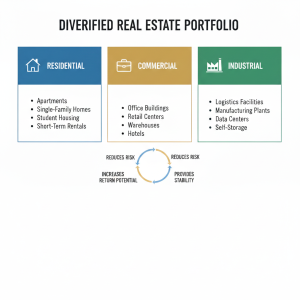
Understanding the 5 Pillars of Real Estate Diversification
A strong real estate portfolio balances across five critical dimensions:
- Asset Type
- Location & Market Cycle
- Income vs Appreciation
- Risk Level
- Investment Timeline
You don’t need dozens of properties; you need strategic balance.
Step 1: Diversify by Asset Type
In 2026, the most resilient portfolios combine:
1. Residential Rental Properties
Your cash-flow engine.
- steady monthly income,
- high tenant demand,
- inflation-protected rent growth.
2. Land Banking
Your long-term wealth accelerator.
- lowest entry cost,
- explosive appreciation in growth corridors,
- minimal maintenance.
3. Short-Let & Hospitality Units
Your high-yield segment.
- premium returns,
- flexible exit options,
- urban & travel-driven demand.
4. Commercial Property
Your stability anchor.
- longer lease contracts,
- higher ticket tenants,
- institutional-grade returns.
5. REITs & Property Funds
Your liquidity buffer.
- easy entry and exit,
- diversification without management burden,
- exposure to large-scale assets.
Each asset behaves differently in various economic conditions — that’s the power of diversification.
Step 2: Diversify by Geography
Never concentrate your entire portfolio in one city or zone.
High-Growth Urban Centers
Lagos, Abuja, Port Harcourt, and Ibadan.
Emerging Growth Corridors
Epe, Ibeju-Lekki, Moniya, Ayetoro, Karshi, Uyo outskirts.
Secondary Cities
Asaba, Akure, Ado-Ekiti, Ilorin.
Geographic diversification protects you from:
- local market corrections,
- political disruptions,
- infrastructure delays.
Read also: Rising Investment Hotspots In Nigeria Beyond Lagos and Abuja
Step 3: Balance Cash Flow & Appreciation
A 2026 portfolio must combine:
Income Assets
Buy-to-let apartments, short-lets, mixed-use retail.
Growth Assets
Strategic land banking, off-plan developments.
Cash flow keeps you solvent.
Appreciation makes you wealthy.
Step 4: Spread Risk Levels
Low Risk:
- residential rentals in established zones,
- REITs.
Medium Risk:
- off-plan properties,
- emerging residential areas.
High Risk:
- speculative land in frontier zones,
- development projects.
Smart portfolios blend all three.
Step 5: Structure by Timeline
Short-Term: REITs, short-lets
Mid-Term: buy-to-rent, off-plan
Long-Term: land banking, development
This keeps your portfolio liquid, growing, and compounding.
How Much Capital Do You Need?
You can begin diversification with as little as ₦3m–₦5m by combining:
- fractional land investments,
- REIT exposure,
- installment-based off-plan units.
Wealth building is about structure, not size.
Common Portfolio Mistakes in Nigeria
- over-concentration in land only,
- chasing hype locations,
- ignoring cash-flow assets,
- weak legal due diligence,
- emotional investing.
Why Real Estate Wins in 2026
- hedge against inflation,
- rising housing demand,
- improving mortgage access,
- infrastructure acceleration,
- strong demographic growth.
Final Thoughts: Build Wealth, Not Just Property
A diversified real estate portfolio is not about owning many properties: it’s about owning the right mix.
When structured properly, your portfolio:
- generates monthly income,
- grows in value every year,
- protects you from financial shocks,
- creates generational wealth.
Start Building Your 2026 Portfolio Today
Explore verified investment opportunities across Nigeria:
https://www.thinkmint.ng/buy-realestate
Your future self will thank you.