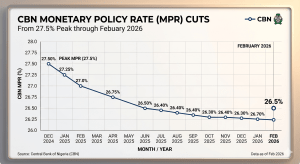
In February 2026, the Central Bank of Nigeria cut its benchmark interest rate by 50 basis points to 26.5% the second cut in six months, following the first reduction since 2020 in September 2025. Headline inflation has dropped to 15.10% in January 2026, down from 33.88% a year earlier. Nigeria’s economy expanded 4.23% year-on-year in Q2 2025, its strongest growth pace since 2021.
Foreign direct investment into Nigeria’s real estate sector reached $1.8 billion in 2025 — the highest annual inflow in five years, according to NBS and CBN preliminary data.
These are not vibes. These are directional signals that are reshaping investment decisions right now across Lagos, Abuja, and every secondary market corridor between them.
The question serious investors are asking is not whether Nigeria’s real estate market is moving. It clearly is. The question is: which segments are moving in your favour, which risks are being systematically underreported, and where exactly is the money going?
Here is the answer, with the data behind it.
Curious where the top investors are placing their bets in 2026?
In this guide, we reveal the 7 hottest Nigerian real estate hotspots, why they matter, and exactly how you can position yourself to profit before the crowd catches on.
.
What 2026 Means for Real Estate Investment in Nigeria
Several forces are converging to make 2026 a pivotal year for property investment in Nigeria:
- Persistent housing deficit estimated in the tens of millions
- Urban migration is accelerating demand for rental and owner-occupied homes
- Infrastructure-led development is opening up new growth corridors
- Inflation and currency risk are pushing investors toward real assets
- Improved land digitisation and mortgage access in key states
Unlike previous cycles driven mostly by speculation, today’s market is increasingly shaped by income demand, livability, and long-term value creation.
This shift is why location selection matters more than ever.
How Investors Identify High-Growth Real Estate Hotspots
Before diving into specific locations, it’s important to understand how serious investors evaluate hotspots in Nigeria’s property market.
Infrastructure & Government Projects
Road expansions, rail links, ports, airports, and industrial zones often precede price appreciation. Real estate growth follows infrastructure, not the other way around.
Population Growth & Urban Expansion
Areas absorbing spillover from overcrowded cities tend to experience sustained housing demand, especially for rentals.
Rental Yield & Occupancy Demand
High-growth areas aren’t just about price appreciation; they offer consistent rental income driven by workers, families, and businesses.
Title Security & Regulatory Clarity
Locations with clearer land documentation, digitised records, and enforceable regulations attract institutional and long-term capital.
Entry Price vs Growth Potential
The best investments are often early-stage markets with reasonable entry prices and strong fundamentals, not already-saturated luxury zones.
Top 7 Nigerian Real Estate Hotspots Investors Are Watching in 2026
1. Lekki–Epe Corridor, Lagos
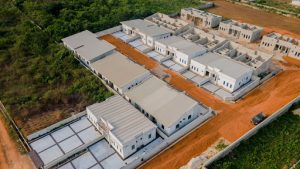
The Lekki–Epe corridor remains one of the most closely watched real estate zones in Nigeria.
Once considered Lagos’ fringe, the corridor has matured into a mixed-use economic spine, driven by residential estates, commercial hubs, and improved connectivity.
Why investors are watching:
- Ongoing road expansions and infrastructure upgrades
- Proximity to business districts and employment centres
- Strong demand for mid-range and serviced apartments
- High rental occupancy driven by professionals and families
While prices have risen over the years, select pockets within the corridor still offer solid rental yields and long-term appreciation, especially for well-located developments with proper titles.
Investor takeaway:
Best suited for investors seeking balanced income and appreciation rather than speculative land plays.
- Ibeju-Lekki, Lagos
Ibeju-Lekki continues to dominate conversations around long-term property investment in Nigeria.
Still relatively affordable compared to Lekki Phase 1, the area benefits from its position along Lagos’ expanding eastern axis.
Why investors are watching:
- Lower entry prices compared to central Lagos
- Long-term industrial and logistics growth prospects
- Increasing residential demand as workers move closer to new economic zones
- Ideal for land banking and phased residential development
That said, investor success in Ibeju-Lekki depends heavily on documentation, location specificity, and patience.
Investor takeaway:
A classic early-entry growth market with high potential, but requires due diligence and a long-term horizon.
- Abuja Growth Corridors (Lugbe, Karsana, Gwagwalada)

Abuja’s core districts are increasingly saturated and expensive. As a result, investor focus has shifted to growth corridors surrounding the city centre.
Areas like Lugbe, Karsana, and Gwagwalada are absorbing demand from:
- Government workers
- Private sector professionals
- Young families priced out of central districts
Why investors are watching:
- Expanding road networks improves accessibility
- Government-driven housing demand
- Stable rental income from civil servants
- Growing demand for affordable and mid-income housing
Abuja’s relatively structured planning and regulatory environment also makes these corridors attractive to cautious investors.
Investor takeaway:
Strong option for stable rental income and moderate appreciation, especially in properly planned estates.
- Ibadan (Moniya, Apata, Ido Axis)
Ibadan’s real estate renaissance is no longer speculative; it’s happening.
Driven largely by Lagos spillover, improved transport links, and significantly lower property prices, Ibadan has emerged as one of Nigeria’s fastest-growing property markets.
Why investors are watching:
- Affordable land and housing entry points
- Rising demand for rental housing
- Improved road connectivity to Lagos
- Growing commercial and educational activity
Areas like Moniya, Apata, and the Ido axis are seeing steady residential development catering to workers, students, and families.
Investor takeaway:
Ideal for investors seeking early growth markets with strong demand fundamentals and manageable risk.
- Asaba, Delta State
Asaba has quietly transformed into a strategic real estate hub in the South-South region.
Its location along major transport routes and proximity to commercial cities give it an advantage over more congested urban centres.
Why investors are watching:
- Growing middle-class population
- Rising demand for modern residential estates
- Strategic connectivity to commercial zones
- Relatively stable property prices compared to larger cities
Residential demand in Asaba is driven by professionals, government workers, and families seeking quality housing without mega-city congestion.
Investor takeaway:
Strong choice for mid-term residential investments with consistent rental demand.
- Port Harcourt
Port Harcourt remains an important real estate market, particularly in select districts with better infrastructure and security.
Despite economic fluctuations, housing demand remains steady due to:
- Energy sector employment
- Corporate housing needs
- Demand for serviced apartments
Why investors are watching:
- Stable demand for rentals in prime districts
- Growth in serviced and short-let apartments
- Infrastructure upgrades in select zones
The key here is location selection; not all parts of the city perform equally.
Investor takeaway:
Best for experienced investors focused on rental income, not speculative appreciation.
- Akure & Ado-Ekiti (Emerging University Towns)
Smaller cities are increasingly attracting investor attention due to predictable rental demand and low entry costs.
Akure and Ado-Ekiti benefit from:
- Large student and academic populations
- Government institutions
- Growing residential demand from workers and families
Why investors are watching:
- Low acquisition costs
- Consistent rental occupancy
- Reduced market volatility
- Long-term appreciation potential as urbanisation continues
While returns may be slower compared to major cities, risk levels are often lower.
Investor takeaway:
Excellent for defensive, income-focused portfolios and first-time investors.
Risks Investors Should Watch in 2026
Even in high-growth markets, risks remain. Investors should be cautious of:
- Properties with unclear or disputed titles
- Overpriced developments driven by hype
- Weak developer credibility
- Infrastructure projects that remain uncompleted
- Poor liquidity in overly niche locations
Smart investing in 2026 requires verification, patience, and data-driven decision-making.
Smart Investment Strategies for 2026
To succeed in Nigeria’s evolving real estate market, investors should:
- Enter growth corridors early
- Prioritise title-secure properties
- Balance rental income with long-term appreciation
- Diversify across cities and asset types
- Use structured payment plans and mortgage options where possible
Real estate in 2026 is less about speculation and more about strategic positioning.
Frequently Asked Questions
Which city is best for real estate investment in Nigeria in 2026?
There is no single “best” city. Lagos growth corridors, Abuja outskirts, and emerging cities like Ibadan and Asaba each offer different risk-reward profiles.
Is Nigerian real estate still profitable in 2026?
Yes, especially for investors focused on rental income, infrastructure-backed growth areas, and long-term holding strategies.
How much capital do I need to invest in Nigerian real estate?
Entry points vary widely. Some emerging markets allow entry with relatively low capital, while prime urban areas require significantly more.
What the Data Actually Says About Investing in Nigeria Right Now
Here is a plain-language summary of what the evidence supports:
Favourable for investors in 2026:
- Mid-market residential in proven rental corridors (Yaba, Ikeja, Lekki Phase 1, Wuse 2) with 6–8% net yields
- Short-let properties in high-demand Mainland and Island locations with strong management discipline
- Logistics and warehousing near port and rail infrastructure — $11 billion market, structurally undersupplied
- Infrastructure-corridor land banking with verified C of O in growth pathways
- Entry ahead of CBN rate normalisation, which will support capital values as mortgage affordability improves
Requires caution:
- Luxury Island properties at current pricing — yields are compressed, and holding costs are high
- Off-plan projects from developers without completed project track records
- Any property without a verified C of O in a Lagos area with active demolition enforcement
- Any transaction without independent legal verification at the Land Registry
The most important insight for 2026: Nigeria’s real estate market does not reward passive optimism. It rewards disciplined analysis, that is, understanding where the infrastructure money is going, what the documentation says, and what the yield mathematics look like at the specific location and price point under consideration.
The investors winning in 2026 are not the ones with the most enthusiasm. They are the ones with the most accurate information.
Ready to Explore Investment-Ready Properties?
If you’re looking to invest in verified properties across Nigeria’s fastest-growing real estate markets, explore curated listings and opportunities designed for long-term value: https://www.thinkmint.ng/buyrealestate/
The right location today can define your returns tomorrow.